
Quick answer: Most permanent commercial awnings in Los Angeles County and Clark County, NV require a building permit, and both regions add structural requirements the rest of the country doesn't deal with — seismic bracing in California, and wind-load engineering for gusts up to 115 mph in Southern Nevada. Fixed awnings suit year-round storefront branding; retractable awnings suit patios and seasonal shade. Vinyl holds up best for food service; acrylic canvas holds color longer for retail. Installed costs typically run $12–$40 per square foot depending on material, motorization, and custom branding.
Introduction
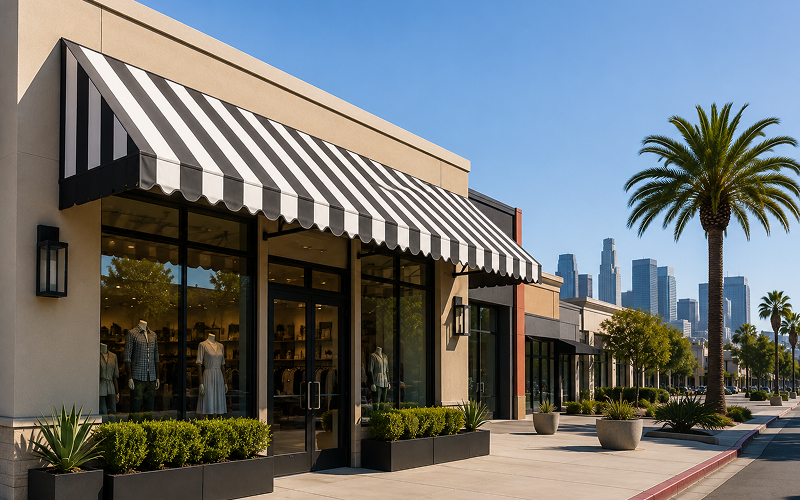
An awning does more for a storefront than most business owners give it credit for. It shades customers during hot summers, protects signage and merchandise from fading, and functions as a form of free, passive advertising every time someone walks or drives past.
At The Awning Cleaners, we build and maintain custom awnings for businesses across Los Angeles County and Nevada. Ordering one isn't as simple as picking a color and a fabric — there are permitting rules, structural codes, and material trade-offs that materially affect what an awning costs and how long it lasts. This guide walks through what's actually involved in 2026, region by region.
Commercial Awning Permits: LA County & Clark County, NV Compared
Permit rules aren't uniform even within a single county — jurisdiction (city vs. unincorporated county), awning projection, and building type all change the answer. Here's how the two main jurisdictions we serve actually compare:
| Requirement | City of Los Angeles | LA County (Unincorporated) | City of Las Vegas / Clark County, NV |
|---|---|---|---|
| Permit-exempt projection | Up to 4 ft from exterior wall (outside Fire District No. 1, Group R only) | Up to 54 in. from exterior wall (Group R-3/U only) | Generally not exempt — most permanent covers require a permit |
| Governing code | LA Municipal Code $91.106 | LA County Building Code (Title 26) | 2024 IBC (Clark Co., adopted Jan. 2026) / 2021 IBC (City of Las Vegas) |
| Lateral load engineering | Seismic bracing required, all permanent structures | Seismic bracing required, all permanent structures | Wind-load engineering required (design speeds up to 115 mph, ASCE 7) |
| Seismic Design Category | High seismic zone | High seismic zone | Category B–C (moderate) |
| Stamped engineering drawings | Typically required for permanent commercial installs | Typically required for permanent commercial installs | Required for wind-load calculations on attached structures |
| Fire-rated fabric | Required per LAMC | Required per Title 26 | NFPA 701 flame-spread compliance required (Clark Co. Bldg. Code Ch. 31) |
What this means in practice: a commercial awning that clears LA's projection exemption can still trigger a permit if it's motorized, if it's in a fire district, or if the building is a commercial (not residential) occupancy — which most storefronts are. In Nevada, the deciding factor is usually less about projection and more about wind load: anything permanently bolted to a building needs engineering showing it can withstand the region's design wind speeds. A reputable commercial awning company handles the plan check and engineering as part of the install — but it's worth knowing upfront that "we'll install it Tuesday" isn't realistic for a permanent commercial structure in either region.
Fixed vs. Retractable Awnings: Which Fits Your Business?
| Factor | Fixed Awning | Retractable Awning |
|---|---|---|
| Best for | Storefront branding, year-round shade & signage | Restaurant patios, outdoor seating, seasonal sun control |
| Structural permanence | Permanent, bolted structure | Arm-and-frame system, fabric retracts |
| Maintenance | Lower — no moving parts | Higher — motor, arms, and sensors need annual checks |
| Typical installed cost | $6–$9/sq ft labor + materials | $12.50–$27.50/sq ft installed |
| Wind/storm handling | Fixed exposure — must be engineered for full load | Can retract during high wind, reducing structural demand |
| Lifespan driver | Fabric UV exposure (constant) | Fabric UV exposure (only when extended) |
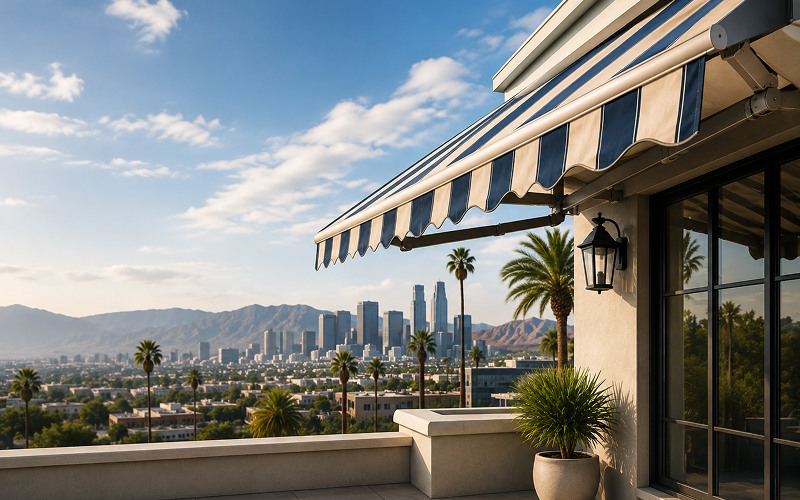
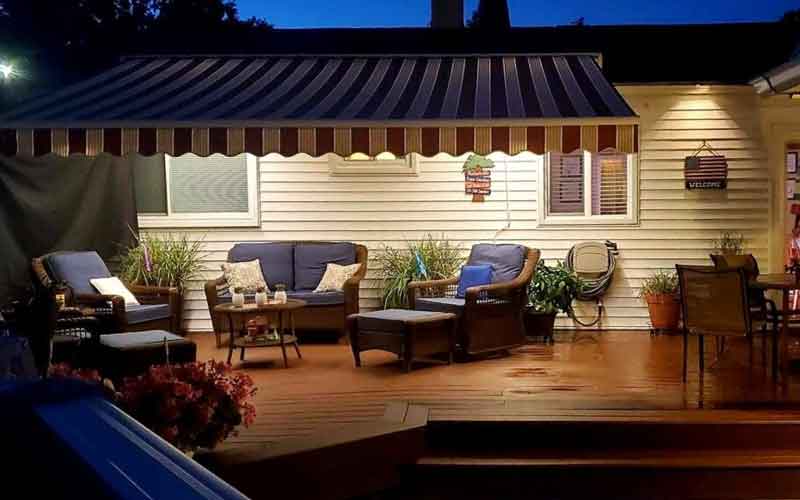
Fixed awnings are the stronger pick when the goal is consistent branding and shade every day of the year — they're a structural fixture, not equipment, so there's less to service. Retractable awnings trade some of that permanence for flexibility: a restaurant patio that wants full sun in cooler months and shade in summer benefits from being able to adjust day to day. Neither is categorically better — it depends on whether the business needs the awning to behave the same way every day or needs it to adapt.
Material Selection: Vinyl vs. Acrylic Canvas
| Property | Commercial Vinyl (Laminated) | Acrylic Canvas (Solution-Dyed) |
|---|---|---|
| Best for | Food service, restaurants, high-grime environments | Retail storefronts, signage-forward installs |
| Moisture/mold resistance | High — wipes clean, resists mildew | Moderate — breathable but needs regular cleaning |
| Color retention in direct sun | Fades faster under sustained UV | Holds color longer (solution-dyed fibers) |
| Typical lifespan, LA coastal | 15–20+ years | 10–15 years |
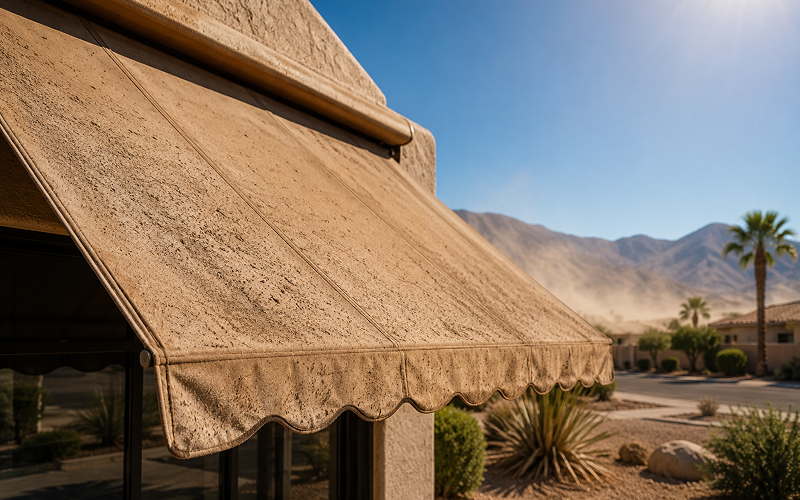
| Typical lifespan, Nevada desert | 5–8 years | 8–12 years |
| Breathability | Low | High — better airflow, cooler underneath |
| Cleaning | Easier — smooth surface | Requires more careful, fabric-safe cleaning |
Vinyl's moisture resistance and easy wipe-down make it the practical choice for a restaurant or food business dealing with grease and steam. Acrylic canvas breathes better and holds color longer under direct sun, which matters more for a retail storefront where the awning is doing visual branding work all day. Choosing the wrong material for a building's actual sun exposure is the most common reason a custom awning looks worn out years before it should — this shows up fastest in Nevada, where desert UV load cuts vinyl's practical lifespan roughly in half compared to LA's coastal climate.
What Custom Commercial Awnings Cost in 2026
Based on current national installed-cost data, here's how commercial-grade projects typically break down:
| Project Tier | Fabric & Frame | Install Complexity | Installed Cost Range |
|---|---|---|---|
| Basic (fixed, standard vinyl, aluminum frame) | Standard vinyl | 4–6 hrs labor | $6–$9/sq ft |
| Mid-range (acrylic, reinforced frame, wind sensor) | Premium acrylic | 8–12 hrs labor | $12–$25/sq ft |
| Premium (motorized, custom branding, steel frame) | Premium acrylic or vinyl | 1–2 days, electrician required | $20–$40/sq ft |
| Metal/architectural awning | Aluminum or steel | Multi-day, structural engineering | $36–$47/sq ft |
Separate line items to budget for: permit fees ($25–$100 in most jurisdictions), electrician for motorized systems ($200–$500), and stamped engineering drawings where seismic or wind-load calculations are required — often a fixed fee on top of the awning itself, and non-negotiable for permanent commercial installs in either LA County or Clark County.
Why the Awning Doubles as Signage: The Data
A custom awning isn't just shade — it's one of the only pieces of signage that works passively, all day, without ongoing ad spend. The broader retail-signage research backs this up:
- Roughly 7 in 10 consumers say they associate the quality of a business's exterior signage with the quality of what's inside.
- Research on storefront visibility has found that a majority of consumers are unlikely to walk into a store with unclear or absent signage.
- Industry estimates put a meaningful share of walk-in customer stops — reportedly close to half — as impulsive, triggered simply by noticing the sign or storefront while passing by.
- First impressions of a storefront are reportedly formed in a matter of seconds, which is why legibility (color contrast, font size, logo placement) matters more on an awning than it would on a sign people are already standing still to read.
The practical takeaway: logo placement, color-matching to existing branding, and font legibility from a moving car all matter more on an awning than most business owners initially plan for.
Long-Term Asset Maintenance
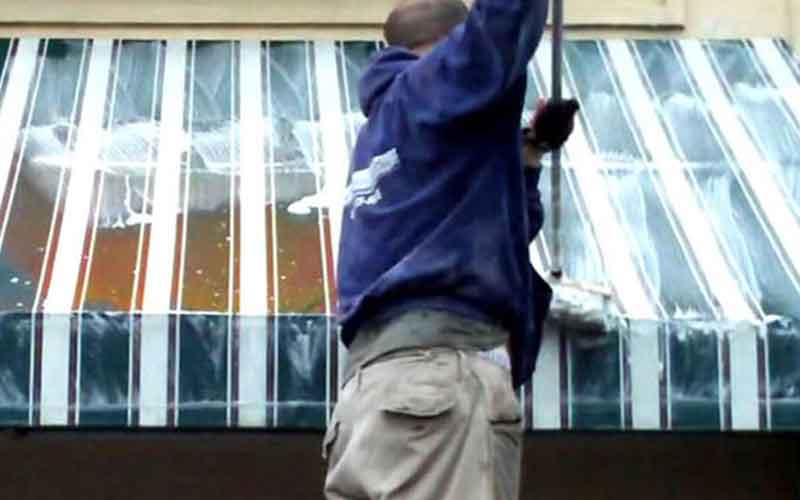
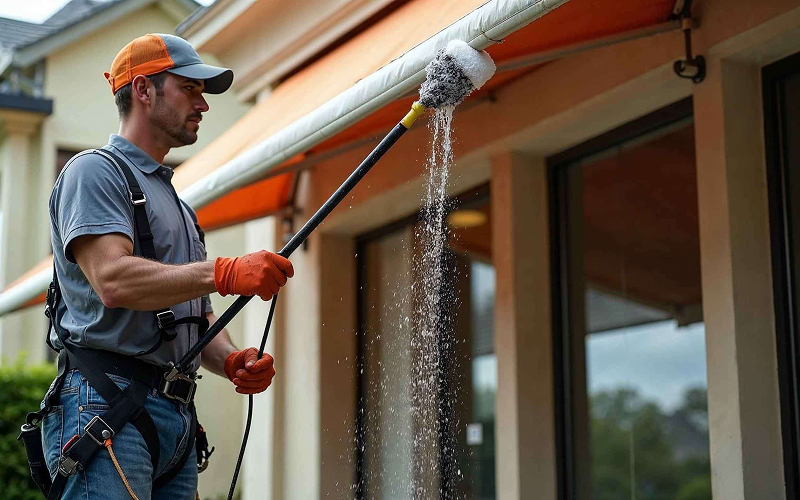
A custom awning is only a long-term asset if it's actually maintained. Regular cleaning prevents the fading and grime buildup that make even a well-installed, well-permitted awning look neglected within a couple of years — undermining the exact branding value it was installed to provide. (See our 2026 awning maintenance checklist for a full seasonal care schedule specific to LA County and Nevada climates.)
Frequently Asked Questions
Do I need a permit for a commercial awning in Los Angeles?
Almost always, yes, for a permanent installation. The City of Los Angeles exempts awnings that project no more than 4 feet from the wall on Group R (residential) occupancies outside Fire District No. 1; LA County's unincorporated areas exempt up to 54 inches on Group R-3/U occupancies. Most commercial storefronts fall outside these narrow exemptions and require a permit with seismic bracing calculations.
Do commercial awnings need engineering in earthquake zones?
Yes. California's building code requires all canopy and awning structures to be designed for seismic forces, which typically means stamped engineering drawings even for a straightforward shade structure — this applies throughout LA County regardless of jurisdiction.
Is a permit required for awnings in Las Vegas or Clark County?
In most cases, yes, for anything permanently attached to a building. Clark County and the City of Las Vegas require wind-load engineering for permanent structures, since the region's design wind speeds can reach 115 mph. Freestanding or smaller fabric canopies may be exempt, but permanent commercial awnings almost always need a permit and plan review.
Which lasts longer in Nevada heat: vinyl or acrylic?
Acrylic canvas generally outlasts vinyl in Nevada's dry, high-UV climate — typically 8–12 years versus 5–8 years for vinyl, which tends to stiffen and crack faster in sustained desert heat. In LA's milder, more humid coastal climate, vinyl's moisture resistance lets it last 15–20+ years.
How much does a custom commercial awning cost?
Installed commercial awnings typically run $6–$9 per square foot for basic fixed vinyl systems, $12–$25 per square foot for mid-range acrylic and motorized systems, and $20–$47 per square foot for premium, motorized, or architectural metal awnings — before permit fees and any required structural engineering.
Should a restaurant patio choose a fixed or retractable awning?
Retractable is generally the better fit for restaurant patios and outdoor seating, since it allows full sun exposure in cooler months and shade in peak summer heat — flexibility that a permanent fixed awning can't offer.
The Awning Cleaners designs, installs, and maintains custom commercial awnings across Los Angeles County and Nevada (Las Vegas, Henderson, Reno). If you're ready to talk through what a custom commercial awning would actually look like for your business — permits, materials, and budget included — call (323) 273-3058 or request a free quote.
Summary
Installing a commercial custom awning is a high-value investment that functions as passive branding, weather protection, and outdoor shelter for businesses across Los Angeles County and Nevada. Key considerations include navigating local permitting, seismic bracing, and sidewalk clearance regulations. Businesses must strategically choose between fixed structures for permanent year-round branding or retractable systems for seasonal flexibility, alongside selecting appropriate materials—such as easy-to-clean vinyl for restaurants or breathable, color-fast acrylic canvas for retail storefronts. Ongoing professional maintenance is essential to preserve durability and visual impact.
Regulatory & Permit Requirements
Commercial installations in Los Angeles and Nevada require strict compliance with public right-of-way clearance, local municipal permits, and California seismic bracing rules.
Functional Style Selection
Fixed awnings offer continuous structural branding, whereas retractable systems provide adjustable shade tailored for restaurant patios and multi-use outdoor spaces.
Strategic Material Choices
Vinyl offers moisture resistance and simple cleaning for food service, while acrylic canvas provides superior UV resistance and breathability for retail storefronts.
Passive Advertising & Signage
Custom awnings double as permanent, high-visibility signage; logo placement, font scale, and brand color alignment must be optimized for vehicular and foot traffic visibility.
Long-Term Maintenance Planning
Scheduled cleaning and maintenance are critical to preventing grime, fading, and early structural wear, ensuring a longer return on investment.